
Fernando
de Vilallonga
Llançanencs d'Or
Ferran Vilallonga i Rosell
Beyond the strict merits of a humanitarian achievement.
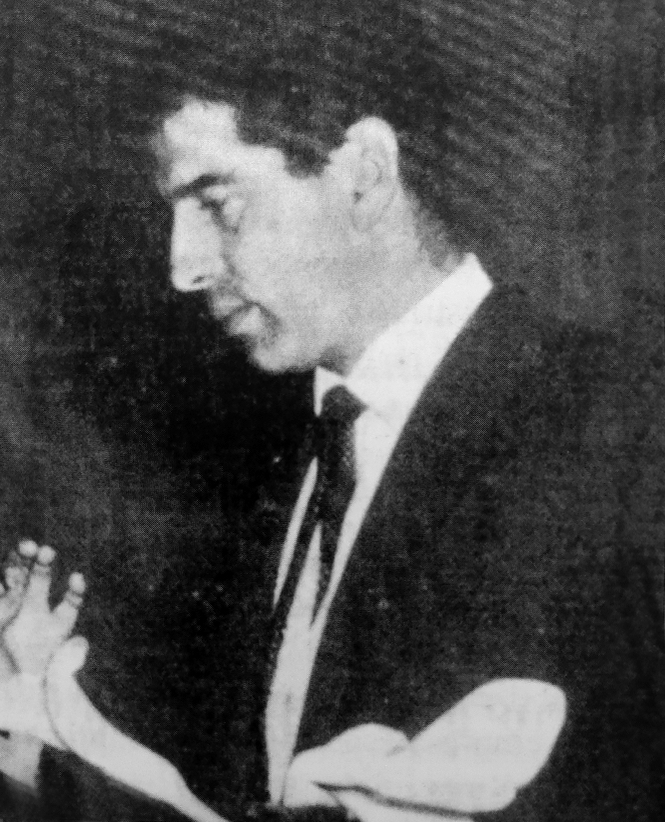
It was the summer of 1961, when Mr. Ferran Vilallonga did a heroic act in the waters of Cap de Creus, where he saved the life of a scuba diver who had just suffered a crisis that could have been fatal. That event was crucial because, some months later, in January 1962, he was awarded with his second Llança d’Or. Nevertheless, we cannot narrow it down to that specific event, as he was having a much more relevant role in the life of Llançà those years; in any case, a much less evident importance.
He was born in Santa Coloma de Farners in 1924 and passed away seventy years later. He was the heir among seven brothers, who became orphan due to the vicissitudes of the Civil War. As a rural landowner, he was persecuted by the uncontrolled squads of the time, which finally forced him to try to cross the Pyrenees to enter the National area. However, that attempt failed near the collada de Toses, mainly because of the hard winter cold.
AThat event, having to take the family responsibilities at a very young age, probably had something to do with his self-making as a sharp and bright person.
—“They are people who made themselves, as they were forced by the situation then” cleverly claims his widow, Mrs. Maria Rosa Ginjaume, at the family residence near Farella.
His link to Llançà grew because of his relationship with her, member of a family who spent the summers in Port. Their marriage favoured even more his links with Llançà, which were boosted by his vocation for the real estate business where he purposely put all his efforts on and achieved a great success during those years. At a time when this industry was starting to expand, even though many people would not see it coming. Tourism seemed a utopia. Nobody believed in it. He had a vision of the future, he saw things had to change. He sometimes bought some land that everybody considered worthless, however, little by little, things started to change.
—This vision of the future led him to develop the residential area of Fané, first thing he had to do is to ensure the water and electricity supplies and the urbanisation. In any case, that might not have been such a difficult endeavour for someone who designed and developed such a spectacular initiative as Empuriabrava, in a quite unusual process Mrs. Vilallonga explains in detail.
—He loved flying; he had got the private pilot flying license in Perpinyà. He knew some people and he noticed there were exchanges among pilots from different countries, so he believed there should be an airport in the area. He thought that was important, and during his flights he discovered the possibilities in the gulf of Roses. They were looking for a flat land, but all the area was full of marshes and swamps that belonged to several different owners, though most of it belonged to the Marquis of Sant Mori.
From then on, starting from the initial objective of building an airfield, all the rest came as part of a joint venture with the Marquis and Mr. Lorda’s brother-in-law, Miquel Arpa. The idea of the canals came up following the examples of certain similar areas in Miami.
No one believed in Empuriabrava and what it would finally become – insisted Mrs. Ginjaume several times-. The canals were made by workers coming from Galicia that were really skilled at working with stone – she added to show the pharaonic magnificence of the project.
In the issue 32 of Miranda published in September 1961, in the section entitled “Album de la Villa” the following text can be read, under the subtitle of “Rescue”.
“On the 3rd day of this month, Mr. Vilallonga, well-known by everyone, in an act of heroism and love for your neighbour and by making a huge effort beyond his normal abilities, he dived 15 meters down to save a colleague. Find in these lines, my most humble, but friendly and honest congratulations.”
Two issues later, in number 34, published in November 1961, a whole column is devoted to that event headed with the name of its protagonist. Find an excerpt here: “A Sunday morning, September the third. Two boats head toward cap de Creus. Two fishermen in them, Javier Chaparro and Fernando Vilallonga. Once there, the former descends over and over chasing a halibut. When, suddenly, the sea decides to collect its tribute: a young scuba diver, who faints during the immersion.
Unconscious, he sinks metres down the waters. The abyss is terrible. The odds of being saved, scarce.
Mr. Vilallonga had never descended so deep, but overpowered by panic, he dives. The rifle lays on the rocks. The uncertainty of being capable of reaching the man in the deep makes the saviour think about shooting him with the harpoon and then pull him back to the surface. But it is not necessary, with a supreme effort he manages to reach him. Then, during the ascent, the stifling feeling of suffocation. Beyond his own endurance, Mr. Vilallonga reaches the boat. Once there, he faints.
We will be leaving it there. The explanations could go on and on...
In our opinion, this rescue is the most outstanding event of the summer. And Fernando Vilallonga is our most emblematic man."
As can be seen, there is an even naïve effort to create a heroic and moving story. In any case, the most important thing is to show the obvious attention paid to the event by Miranda, and how shocking these events were for the villagers. Mrs. Ginjaume gives some first-hand details that help define the relevance of the event.
“Despite he knew more the land than the sea- he enjoyed hunting, he got interested in underwater fishing here, maybe because of its resemblance to hunting. Before we met, he almost knew nothing about the sea. He used to go underwater fishing without a scuba quite often. That was the result of a series of random coincidences. It was providential. He went to cap de Creus with his three sons on a boat we had that wasn’t very big. And, as they were there, they crossed with another boat where that boy was, who was the runner-up of underwater fishing in Spain. Yes, indeed, he was an expert. They didn’t know each other, but they stopped and spent some time talking. My husband was surprised as the boy carried a belt full of weights. He showed it to him and he showed him how in case of danger, it was really easy to get rid of it and he learned how to do it. This boy was being pulled by the boat with a rope.” Mrs Vilallonga, a person with a lively and refined education, explains the facts in a totally convincing way.
“The boy dived in. My husband had a mirror on the boat and he used it to see how he was going deeper, then he realised that as he reached the bottom, he dropped the rifle and lied there. Then, he said “Something wrong is happening to him” And he thought he wouldn’t reach him. That’s why he took the rifle as he thought that sticking it onto his leg, he could drag him. But he managed to reach him, as he had learned to get rid of the belt, he did it, and he made a huge effort to pull him without using the rifle.”
At this point, she says the ultimate statement: “-You do these kind of things without overthinking, he just thought: “he must be saved”. As I mentioned coincidences before, as they reached the surface, there was a boat with some doctors on board who assisted them right there.” As Mrs. Vilallonga explains, apparently, the young boy fainted because he had spent too much time inhaling the exhaust fumes of the boat and that, together with the over exertion of the immersion, caused the accident.
Three months of recovery were the result for that young diver, whereas that extraordinary effort left no trace on Mr. Vilallonga’s health. Some trace was left on his spirit though, as Mrs. Ginjaume explains when I ask her if he remembered that event vividly.
“-A lot, he was extremely affected by that. He was so impressed that he never went underwater fishing ever again. He refused to take the rifle from then on.”
Mr. Vilallonga did more for Llançà besides urbanising Fener or giving the name of the village to the feat we have just remembered. In the issue 42 of that mentioned and remarkable magazine from Llançà, they talk about a project to organize a music festival supported by him, a festival that was originally meant to be organized by the magazine, which finally couldn’t for several reasons. He was friends with mosén Benet and that meant something.
“He was a personality, mosén Benet. He had a terrific energy. He had taught Latin to my kids”- as Mrs. Ginjaume remembers. And then adds:
“-My husband was always there to help anyone who asked for it. No matter if he couldn’t, he always tried to. He always had the intention to help. And not only here, also in other places. Many times, he did things and you’d never know. Probably, he helped Mosén Benet in his initiatives here. He was a religious man; he belonged to a very religious family. His father had been persecuted before the war. My husband managed to sneak him, tucked in a mattress on a cart, pretending they were moving some furniture and crossed the militia lines to take him to Sant Feliu de Pallarols. And he was just a boy and had to take the lead. They had to make espadrilles to have a living, which were designed by his father. And when he found out about his father’s death at the collada de Toses, he located his corpse and buried it in Santa Coloma de Farners. He was part of a group of people who had to face the hardest circumstances. They were self-made people, because the situation forced them to” – Mrs Ginjaume repeats once again.
Let’s get back to this essential document of the history of Llançà, which is the facsimile collection of all the issues of Miranda. In issue 36, published in January- February 1962, entitled “The second Festa de les Llances was an emotional event”, the subtitle highlights the award given to Mr. Ferran Vilallonga as it says:
“Now that we are back, let’s consider serenely: Llances (spears) are a serious commitment.
They are human evidence of merit acknowledgment and we cannot ignore their alert, as their sharp straight lines must aim correctly. And that apparent stagnation turns out to be false, as they keep a silent but constant activity.”
The column stresses later on:
“Mr. Vilallonga uttered his heartfelt words of thanks and unexpectedly, Mr. Chaparro, father of the rescued diver, took part filling the atmosphere with emotion, which overflew in the form of a frenetic applause as those who could avoid tragedy hugged each other before us.”
Let’s finish with some words by Mrs. Ginjaume we think will be really useful to finally define the figure of Mr. Vilallonga:
“-More than an important person, he was a unique one. He was way out of what was ordinary in people. He had a special charm, because he saw many things the others couldn’t see. He seemed to be able to see the future and in fact, he did.”
 Download this article as pdf


